Simple dynamic pricing rules for small properties
You do not need a revenue manager to price well. A handful of clear rules, set once and checked every month, gets a small hotel or villa most of the benefit of dynamic pricing.

Why fixed prices lose money
A fixed price is too low on busy nights and too high on quiet ones. On a fully booked weekend you could have earned more, and on a slow Tuesday the room stays empty. Dynamic pricing simply means your price follows demand, within limits you choose.
For a small property the aim is not to change prices every hour. It is to stop leaving money on the table during peak periods and to fill more nights in quiet weeks.
It also saves time. Once rules are set, you no longer need to decide every morning whether to change prices for next weekend. You decide the logic once, check it monthly and let the system do the daily work. That consistency is especially useful when the owner is not on site and staff handle the front desk.
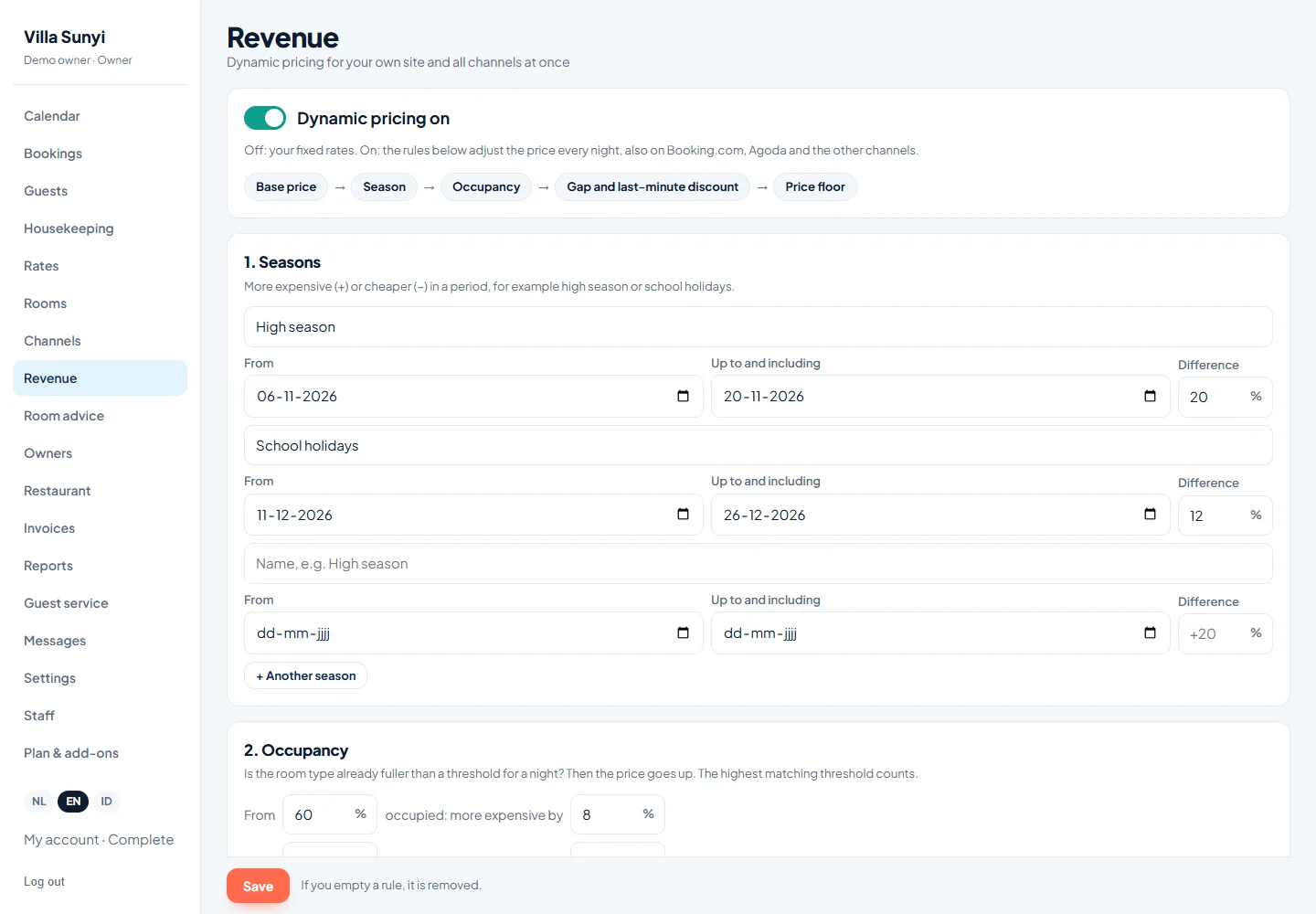
Five rules that cover most of it
- Seasons. Set a base price per season: high season, shoulder and low season, plus special periods like Christmas, New Year and local holidays. This is the foundation everything else builds on.
- Occupancy steps. Raise the price as your property fills. For example, add a set percentage when you are more than half full and a bit more again when only one or two rooms are left. Your last room is your most valuable one.
- Last-minute. If a room is still empty a few days before the date, a modest discount can fill it. Keep it small and only for dates that are clearly not filling.
- Gap nights. A single free night between two bookings is hard to sell. A discount on that one night, or allowing a one-night stay only for gaps, turns dead nights into revenue.
- A price floor. Set a minimum price per room type that no rule can go below. This protects you from discounts stacking up and covers your costs on every night.
How the rules work together
Start with the seasonal price, apply the occupancy step, then the last-minute or gap-night discount if it applies, and finally check the result against your floor. Writing the rules down in this order keeps them predictable, so you always understand why a night costs what it costs.
Local events need their own attention. In Bali, Nyepi closes the island for a day, so that night should simply be closed on every channel rather than priced. Big holidays such as Christmas, New Year and Indonesian public holidays usually deserve their own seasonal price, set months in advance, so early bookers do not take your best nights at low-season rates.
Prices then need to reach every channel. Changing rates by hand on four extranets is where most owners give up. A system that applies your rules and sends the result to all OTAs and your booking page keeps everything consistent. In Sojodesk, dynamic pricing covers seasons, occupancy, last-minute, gap discounts and a floor price, and updates the connected channels.
Check and adjust monthly
Once a month, look at occupancy, average daily rate (ADR) and revenue per available room (RevPAR) for the past weeks and the coming months. If high season is filling very early, your seasonal price is probably too low. If last-minute discounts are used every week, your base price may be too high.
Change one rule at a time, so you can see what effect it has. Small, regular adjustments work better than big changes after a bad month.
Common questions
Will dynamic pricing annoy repeat guests?
Most travellers are used to prices that change with season and demand. You can still give repeat guests a personal offer through your direct booking page.
How big should occupancy steps be?
Start modestly and adjust based on results. The right size depends on your market and how quickly you usually fill.
Should every room type follow the same rules?
Usually the same logic works, but each room type should have its own base price and floor, since a pool villa and a standard room have different demand.
See Sojodesk with your own rooms
Tell us about your property and we will set up a demo with your room types, rates and channels.
Request a demo